Florence Township, street by street
Six sections: the river village, the company town, the highway strip, the industrial parks, the inland subdivisions and the river edge where the mill used to be.
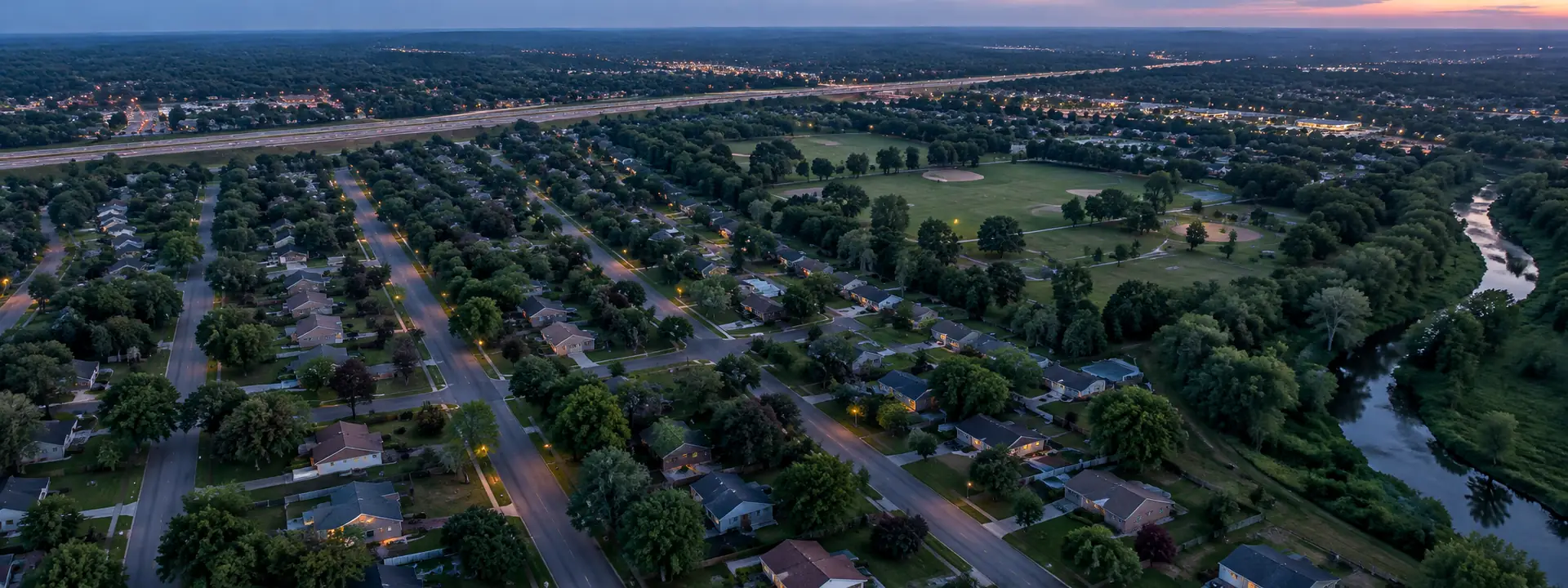
Start with which village
Florence Township contains two places that feel like towns and a third that does not. Florence village runs back from the Delaware on streets laid out in the 19th century. Roebling is a grid of brick houses built in 1905 by a company that needed somewhere for its workers to live. The Route 130 side is warehouses, retail and the turnpike interchange.
The two villages have different house types, different lot patterns and different parking, and they attract different buyers. Pick the village first, then the street, then the house. That order will save you showings.
Florence village and West Front Street
Florence village is the older of the two, a river settlement that became an iron town in the 1850s when Richard Jones established the Florence Iron Works. The streets run back from West Front Street and the Delaware, with a mix of detached houses, twins and a few larger buildings from the industrial years.
The village has the walkability that Roebling has in a different form: narrower streets, older trees, a commercial stretch along the main road, and the river at the end of the blocks. Houses here are older than in Roebling and more varied in size, which means condition matters more than address.
The practical checks are the ones that come with 19th century construction: the electrical service, the heating system, the foundation and the basement, and whether an addition or a finished attic was permitted. A pre-1950 house near the river also deserves a flood check, because the lowest streets are genuinely low.
On this street
- Character: 19th and early 20th century village
- Anchor: West Front Street and the river
- History: Florence Iron Works, established 1857
- Check: Electrical, foundation, flood
Roebling, the company town
Roebling was built in 1905 by John A. Roebling's Sons to house workers at the Kinkora Works, the wire rope and steel plant on the river. The company filled about fifty acres of marsh, laid out a grid, and built roughly 750 brick homes, along with the commercial and civic buildings a town needed.
That origin shows in the housing. The houses are brick, modest in size, close together and consistent in style, mostly twins and short rows. They were built to a plan rather than one at a time, so the block has a coherence that few places in the county can match, and the lots are small with rear alleys in places.
For a buyer, the trade is straightforward. You get solid brick construction, a walkable grid, a train station and a price below the township average. You give up square footage, a garage on most blocks, and the kind of wholesale renovation that a newer house allows. Roebling is also a historic resource, so exterior changes may involve review.
On this street
- Built: 1905, by John A. Roebling's Sons
- Homes: About 750 brick houses
- Types: Twins and short rows on a grid
- Station: River Line at Hornberger Avenue
Route 130 and the commercial strip
U.S. Route 130 runs the length of the township and carries the retail and service businesses that serve it: supermarkets, pharmacies, restaurants, auto service and the small offices that cluster along a highway. For daily errands, it is a few minutes from almost anywhere in Florence.
It is also a truck route, and the volume has grown with the warehouses. Houses on or near the corridor get convenience and noise in the same package, and the discount they carry at resale is usually a reflection of that trade rather than a bargain.
Drive any candidate street at 5 p.m. and again at 9 p.m. before you decide. The difference between a block that backs onto the corridor and one two streets back is bigger than the price difference suggests.
On this street
- Route: U.S. 130, north to south
- Character: Retail, service and truck traffic
- Access: I-295 interchange and the turnpike at Exit 6A
- Watch: Noise on the closest blocks
Exit 6A and the industrial parks
The New Jersey Turnpike interchange at Exit 6A connects to Route 130 and opened the township's eastern side to warehouse and distribution development starting in the late 1990s. Since then large footprint buildings have replaced farmland along the corridor, and the truck traffic that serves them is part of the daily picture.
That development is the township's largest ratable and a source of local employment, and it is also the reason some residential streets are louder than their distance from the highway suggests. The road network shows where the trucks run; the township's master plan shows where they are intended to run, which is not always the same thing.
For a household working in logistics or the trades, this is an advantage: a short commute and no bridge. For a household looking for quiet, the eastern side of the township is the wrong place to start.
On this street
- Interchange: New Jersey Turnpike Exit 6A
- Character: Warehouse and distribution
- Era: Late 1990s onward
- Watch: Truck routes and approach roads
The inland subdivisions
Inland from the two villages and away from the highway, Florence has subdivisions and townhouse communities built from the 1980s onward. These are the houses with garages, basements, lawns and modern floor plans, and they are where most of the township's recent growth has landed.
The comparison inside this group is usually about the community rather than the house. A homeowners association brings rules, dues and shared maintenance, and it also protects the look of the neighborhood. A street with no association gives you more freedom and puts the upkeep of the entrance and the open space on whoever happens to care.
Ask for the association budget, the dues and the reserve study, and confirm who replaces the roof and siding on a townhouse. Those questions prevent most of the surprises in this part of the township.
On this street
- Era: Mostly 1980s onward
- Types: Detached, townhouse, some condominium
- Watch: Association dues and reserves
- On townhomes: Confirm roof and siding responsibility
The river, the floodplain and the mill site
The Delaware forms the entire western edge of the township, and the river is both the reason the town exists and the reason parts of it flood. The lowest blocks in Florence village and along the Roebling waterfront should be checked against the current flood map, with an insurance quote in hand before contingencies come off.
The Kinkora Works site is the largest open question. The mill closed in the 1980s, the land was remediated with federal and state involvement, and the township now owns a substantial part of it. The Roebling Museum occupies the 1907 main gate building at 100 Second Avenue and tells the story of the company, the town and the workers.
For a buyer, that means two things. The riverfront is not a finished picture, and what happens on the mill site over the next decade will affect the village around it. Ask what is planned before you buy on the assumption that the view will never change.
On this street
- River: Delaware, the full western edge
- Museum: Roebling Museum, 100 Second Avenue
- Mill site: Kinkora Works, remediated, township owned in part
- Check: Flood map and insurance quote
Cheap to own, mixed to live in
Florence has the lowest tax rate of the towns in this group, an average bill second only to Mount Holly, and two rail stops, which is a combination no other town here offers. It also has more industrial land and more truck traffic than its neighbors, and its two villages are older and smaller than the subdivisions buyers often picture.
If you want a brick house on a walkable grid with a train, Roebling is one of the best values in Burlington County. If you want a newer house with a garage, the inland streets deliver it. What you should not expect is quiet on the eastern side near the interchange.
Want a read on a specific street?
Tell me the address or the block, and I will tell you which village it is in, what the flood picture looks like and how that street has been pricing.
Bob Millaway, REALTOR, Epique Realty. 856.426.1522. New Jersey license #791082.